Complete the following form to download your document.
EXPLICACIÓN DEL
EQUILIBRIO DE MASAS
El tira y afloja del mercado para el cambio
Es fundamental tomar medidas enérgicas contra el cambio climático, como reducir las emisiones, aumentar la eficiencia de los recursos y aprovechar las oportunidades para adoptar soluciones más sostenibles, siendo todos estos factores clave para construir un futuro más sostenible. A lo largo del siglo XX, los proveedores mundiales de productos químicos han dependido en gran medida de los combustibles fósiles para alimentar las instalaciones, mejorar los procesos químicos, crear carteras de productos y efectuar la logística de transporte y distribución. La diversificación y modificación de las materias primas se consideran ahora parte de la solución a la hora de hablar de apartarse globalmente de los combustibles fósiles dentro de la industria.
Junto con este empuje desde dentro de la industria, también ha crecido la demanda (pedido) de materiales reciclados por parte de clientes intermedios. Un reciente informe de [1}[2}Smartest Energy{3]{4] demostró que el 81% de los consumidores son más propensos a elegir una marca que esté realizando acciones positivas hacia un mundo más sostenible. A pesar de ello, el 45% de los consumidores desconoce las prácticas que las marcas han adoptado para fomentar la sostenibilidad medioambiental; por lo tanto, existe una brecha en la ejecución de prácticas respetuosas con el medio ambiente y en la comunicación transparente a lo largo de la cadena de suministro de productos químicos.
The Challenge
The chemical industry uses a small set of raw materials (or feedstocks) to produce tens of thousands of products. Traditionally this feedstock has been derived from fossil-based material.
When recycled feedstocks enter the same manufacturing system as fossil-based feedstocks, they cannot exist in physically divided flows. Separating and delivering these two different feedstocks at scale is often associated with operational and economic feasibility challenges.
La adopción del equilibrio de masas en la industria
En un intento por llenar este vacío, el enfoque de equilibrio de masas se ha impuesto en la industria química, con un énfasis creciente en los últimos años.
En la actualidad, la bioquímica no puede servir como solución viable para efectuar una transición rápida a materias primas renovables a gran escala debido a limitaciones inherentes. Estas restricciones abarcan factores como disponibilidad de materias primas, infraestructura, limitaciones de investigación y desarrollo, así como consideraciones de costes. No obstante, representa un paso importante hacia el establecimiento de una economía circular.
¿Cómo funciona?
El equilibrio de masas es una cadena de custodia en la que materiales certificados y no certificados se mezclan físicamente, pero se mantienen separados contablemente.
Al utilizar el equilibrio de masas, las empresas pueden realizar un seguimiento de la cantidad de material circular, biocircular y biológico que se ha utilizado en sus sistemas de fabricación y asegurarse de que corresponda de manera precisa con la cantidad de contenido certificado en los productos finales.
El equilibrio de masas es un paso gradual para que los fabricantes sustituyan un porcentaje del contenido de combustibles fósiles (no renovables) de un producto por fuentes circulares. Las principales materias primas fósiles de la industria química son la nafta y el gas natural, que se procesan posteriormente mediante craqueo u oxidación parcial a temperaturas elevadas. En los productos, estas materias primas se sustituyen por materias primas biológicas, es decir, bionafta y biogás (biometano), así como por materias primas tradicionales recuperadas y recicladas.
This method achieves an identical product quality and performance to which they are accustomed to and benefit from a sustainable drop-in solution, making a conscious contribution to environmental protection and limiting the climate crisis.
Con este método se consigue que los productos tengan una calidad y un rendimiento idénticos a los que están acostumbrados y se benefician de una solución “drop-in” (intercambiable) sostenible, contribuyendo conscientemente a la protección del medio ambiente y a limitar la crisis climática.
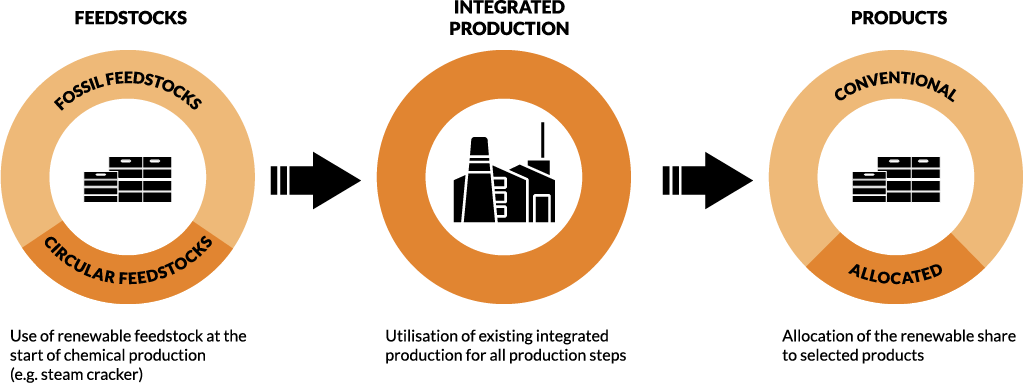
Feedstocks
Use of renewable feedstock at the start of chemical production(e.g. steam cracker)

Integrated Production
Utilisation of existing integrated production for all production steps
Products
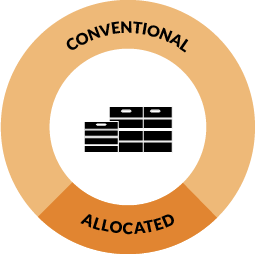
Allocation of the renewable share to selected products
Key benefits of Mass Balance
- Easy accountability
- Gives formulators a sustainable 'drop-in' solution
- Significant reduction of carbon footprint/greenhouse gases
- The same product quality/efficacy is attained
- No need to adapt formulations, plants, or processes
- It can be implemented directly
- Certified according to well-accepted standards like REDcert2
- Removes the need for separate processing units & their potential environmental impact
- Enhances sustainability value proposition of products from source
- Early adoption encourages a gradual increase of renewable feedstock supply
Principales ventajas del equilibrio de masas

Contabilización sencilla

Ofrece a los formuladores una solución sostenible e inmediata.
Reducción significativa de la huella de carbono/gases de efecto invernadero

Se mantiene la misma calidad/eficacia del producto

No es necesario adaptar formulaciones, plantas ni procesos

Se puede implementar de forma directa

Certificado según normas bien aceptadas como REDcert2

Elimina la necesidad de unidades de procesamiento separadas y su potencial impacto medioambiental

Mejora la propuesta de valor de sostenibilidad de los productos desde su origen
ELa adopción temprana fomenta un aumento gradual del suministro de materias primas renovables
Key benefits of Mass Balance
- Easy accountability
- Gives formulators a sustainable 'drop-in' solution
- Significant reduction of carbon footprint/greenhouse gases
- The same product quality/efficacy is attained
- No need to adapt formulations, plants, or processes
- It can be implemented directly
- Certified according to well-accepted standards like REDcert2
- Removes the need for separate processing units & their potential environmental impact
- Enhances sustainability value proposition of products from source
- Early adoption encourages a gradual increase of renewable feedstock supply
Conclusión
El enfoque de equilibrio de masas es un método innovador y a la vez sencillo, que permite evaluar los impactos medioambientales del ciclo de vida de los productos de base biológica y circulares sin crear cadenas de valor enteras separadas de las rutas basadas en los fósiles.
Más sobre Sostenible y Circular
Transición a una economía circular

Descubre cómo Univar Solutions puede ayudarte a recorrer el camino hacia una economía circular, sustituyendo los combustibles fósiles y aplicando con un enfoque de equilibrio de masas.
THE ISCC

ISCC strives for a world where biomass and other raw materials are produced in an environmentally, socially, and economically sustainable manner.
Colaboración entre Dow y Univar

Univar Solutions ha colaborado con Dow para ofrecer sus productos de reciclaje avanzado a nuestros clientes. Descubre cómo esta colaboración podría apoyar tus objetivos de sostenibilidad.
Enlaces y fuentes útiles
- https://www.iscc-system.org/about/circular-economy/mass-balance-approach/
- PlasticsEurope position paper on the "Mass balance approach to accelerate the use of renewable feedstocks in chemical processes" (29 January 2020)
- https://www.epa.gov/ghgemissions/global-greenhouse-gas-emissions-data#:~:text=Since
- https://www.basf.com/global/en/who-we-are/sustainability/we-drive-sustainable-solutions/circular-economy/mass-balance-approach/biomass-balance.html
- https://www.recyclinglives.com/news/general/report-reveals-81-people-prefer-buy-sustainable-sellers
- Study "A methodology for integrating the biomass balance approach into life cycle assessment with an application in the chemicals sector" by Adisa Azapagic et al. in "Science of the total environment" (2019)
- Mass balance approach for the sustainable chemicals transition
As a global leader in chemical and ingredient distribution, we take our Environment, Social, and Governance (ESG) responsibilities seriously, and:

Employ environmentally conscious protocols and technologies

Encourage community engagement

Establish practices and partnerships with integrity
More on Sustainable & Circular
Link to ISCC Acreditation page

cras fermentum odio eu feugiat pretium nibh ipsum consequat nisl vel pretium lectus quam id leo in vitae turpis massa sed elementum tempus egestas sed sed s
ESG Link

cras fermentum odio eu feugiat pretium nibh ipsum consequat nisl vel pretium lectus quam id leo in vitae turpis massa sed elementum tempus egestas sed sed s
Campaign Page Link

cras fermentum odio eu feugiat pretium nibh ipsum consequat nisl vel pretium lectus quam id leo in vitae turpis massa sed elementum tempus egestas sed sed s
Sustainable Solutions
Discover how we can help customers develop and market sustainable products
Sustainable Solutions

Explore how Univar Solutions delivers sustainability solutions to our customers:
- Sustainable & Natural Product Framework
- Sustainable Formulations
- Sustainable Services
2025 Goals
In an effort to drive meaningful change and show our continuous commitment, we've outlined a new set of ESG sustainability goals.
These ambitious standards will allow us to better serve our customers, employees, and partners today, so that together, we can shape a better tomorrow.
2025 Goals
In an effort to drive meaningful change and show our continuous commitment, we've outlined a new set of ESG sustainability goals.
These ambitious standards will allow us to better serve our customers, employees, and partners today, so that together, we can shape a better tomorrow.

Climate Action
Implement technology, processes, and culture to support our sustainability journey.
Reach 20% absolute reduction in CO2e emissions by 2025, and 40% by 2030
Achieve net-zero direct emissions by 2050

Safety
Keep our employees, vendors, and customers safe at work
By 2025, reduce TCIR by 20%
Achieve 100% alignment by and utilization on our global safety program by 2025

Resource Use
Embed the principles of circularity and operational excellence.
Reduce hazardous waste and water waste by 15% by 2025
Triple non-hazardous waste recycling rates by 2025
Introduce sustainble water use at all high-risk sites
Release Prevention
Support the responsible handling of materials across our operations and supply chain.
Reduce significant chemical releases by 40% by 2025

Sustainable Sourcing
Drive improved sustainability performance and minimum standards across our diverse supplier base.
By 2023, get 100% of active suppliers to agree to our Code of Conduct
Assess 80% of suppliers on their sustainability performance (by spend) by 2025

Diversity, Equity & Inclusion
Increase representation across the organization and encourage employees to lead with their authentic selves.
Maintain a 100% score on the Corporate Equality Index, and at least a 78% score on the Employee Engagement Diversity & Inclusion Index
Increase female representation and ethnic diversity at the people leader level (and above) by 2025

Sustainable Solutions
Leverage sustainable products, services, and practices.
Develop sustainable characteristics for all products
Communicate the key sustainability impacts for non-product-related services
Offer circular packaging solutions for all suitable products

Community Engagement
Demonstrate our committment to local communities
Make charitable contributions through the Univar Solutions Foundation (or other similar means)
Establish employee volunteer hour contributions, and company matching gift contributions
Climate Action
Implement technology, processes, and culture to support our sustainability journey.
Reach 20% absolute reduction in CO2e emissions by 2025, and 40% by 2030
Achieve net-zero direct emissions by 2050
Safety
Keep our employees, vendors, and customers safe at work
By 2025, reduce TCIR by 20%
Achieve 100% alignment by and utilization on our global safety program by 2025
Resource Use
Embed the principles of circularity and operational excellence.
Reduce hazardous waste and water waste by 15% by 2025
Triple non-hazardous waste recycling rates by 2025
Release Prevention
Support the responsible handling of materials across our operations and supply chain.
Reduce significant chemical releases by 40% by 2025
Sustainable Sourcing
Drive improved sustainability performance and minimum standards across our diverse supplier base.
By 2023, get 100% of active suppliers to agree to our Code of Conduct
Assess 80% of suppliers on their sustainability performance (by spend) by 2025
Diversity, Equity & Inclusion
Increase representation across the organization and encourage employees to lead with their authentic selves.
Maintain a 100% score on the Corporate Equality Index, and at least a 78% score on the Employee Engagement Diversity & Inclusion Index
Increase female representation and ethnic diversity at the people leader level (and above) by 2025
Resources & Reporting
Explore helpful ESG reporting, performance, and policy resources